Lesson 3: Compiling the Suspect Dossiers
Lesson 3: Compiling the Suspect Dossiers
Objective:
Students will take information from photos and organize them into groups by visual characteristics. They will practice making detailed observations to build a preliminary dossier on their suspects.
Materials:
-
Guess Who? Online Game link: https://www.calculators.org/games/guess-who/
-
Suspect Data Cards (See References for lesson inspiration)
Advanced preparation required. See Class Setup section for additional details.
-
Print Option(s)
NOTE: Options B or C are recommended for Lesson 3. Option A is required for Lesson 4.-
Option A: PDF document of Suspect Data Cards (FULL) - photo on left side; school information on right side: (LMR_U1_L03_A_Suspect_Data_Cards_FULL)
-
Option B: PDF document of left side of Suspect Data Cards (photos + names) with names included: (LMR_U1_L03_B_Suspect_Data_Cards_NAMES_PHOTOS)
-
Option C: PDF document of left side of Suspect Data Cards (photos only) with names excluded: (LMR_U1_L03_C_Suspect_Data_Cards_PHOTOS)
-
-
Digital Option(s)
NOTE: Options E or F are recommended for Lesson 3. Option D is required for Lesson 4.-
Option D: Canva whiteboard template of Suspect Data Cards (FULL) - photo on left side; school information on right side: (LMR_U1_L03_D_DIGITAL_Suspect_Data_Cards_FULL)
-
Option E: Canva whiteboard template of left side of Suspect Data Cards (photos + names) with names included: (LMR_U1_L03_E_DIGITAL_Suspect_Data_Cards_NAMES_PHOTOS)
-
Option F: Canva whiteboard template of left side of Suspect Data Cards (photos only) with names excluded: (LMR_U1_L03_F_DIGITAL_Suspect_Data_Cards_PHOTOS)
-
-
-
Data Cycle poster [pages 2 & 3] (LMR_U1_L01_B_The_Data_Cycle)
Vocabulary:
Essential Concepts:
Essential Concepts:
A core part of being a data scientist is to gather data by making careful observations. Organizing information based on observable traits helps uncover patterns and similarities. These observable traits are characteristics that can differ from one person to another.
Lesson:
Class Setup
-
Advanced preparation required.
-
Prior to class starting, select whether your class will use the print or digital option of the Suspect Data Cards.
-
Print Option(s): [color printing recommended]
Print and cut out enough sets of cards so that each group of 3 to 4 students gets their own set. As an example, if there are 20 students in the class and they are placed into groups of 4, you will need to prepare 5 sets of the Suspect Data Cards. The card sets can be stored in zipper bags or envelopes for easy distribution.
NOTE: Only the left side of the FULL cards will be used for this lesson (the photo side). You can choose to print/cut/prepare just the left half of the cards for this lesson, OR print the entire card and fold it in half OR print/cut/prepare the ‘photos + names’ cards or the ‘photos only’ cards.- Option A (LMR_U1_L03_A): Suspect Data Cards (FULL)
- Option B (LMR_U1_L03_B): Suspect Data Cards (photos + names)
- Option C (LMR_U1_L03_C): Suspect Data Cards (photos only)
-
Digital Option(s):
3 online Canva whiteboard templates have been created for you to copy. Each group would need access to their own whiteboard.- Option D (LMR_U1_L03_D): Canva whiteboard for Suspect Data Cards (FULL)
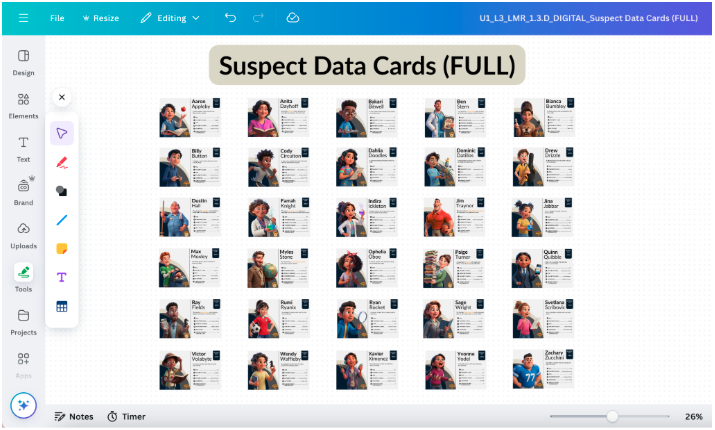
- Option E (LMR_U1_L03_E): Canva whiteboard for Suspect Data Cards (photos + names)
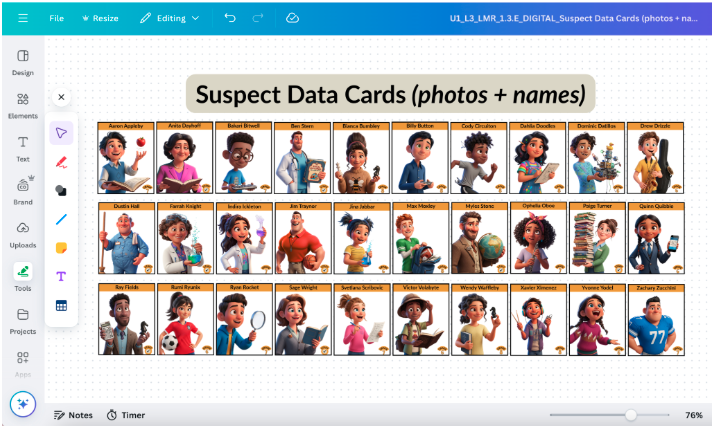
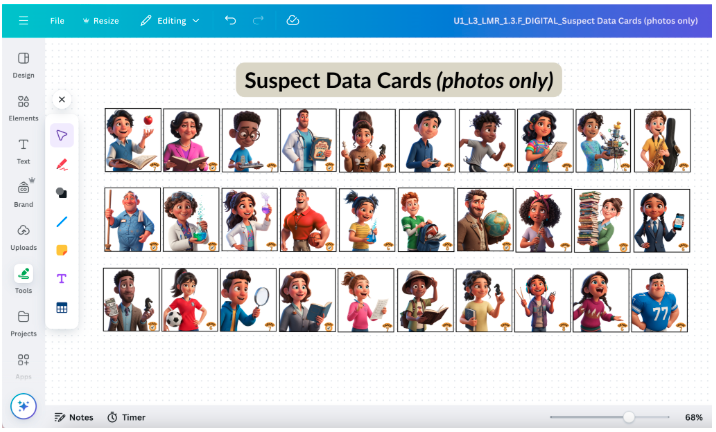
- Option F (LMR_U1_L03_F): Canva whiteboard for Suspect Data Cards (photos only)
-
Opening
-
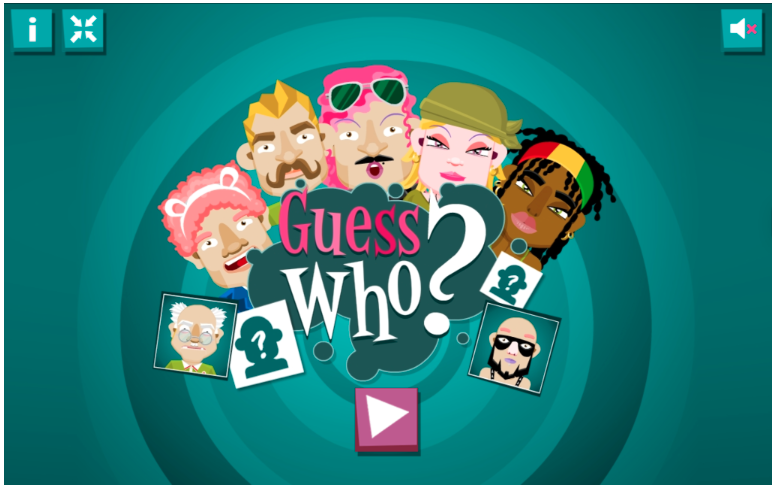
Lesson Hook: Welcome the detectives back to training, and introduce the Guess Who? Online game.
-
Explain that the goal of the game is to guess which character the computer chose before it can guess which character we chose. The list is narrowed down by asking questions about the physical appearance of the characters. Play one round of the game (or 2, if time permits).
-
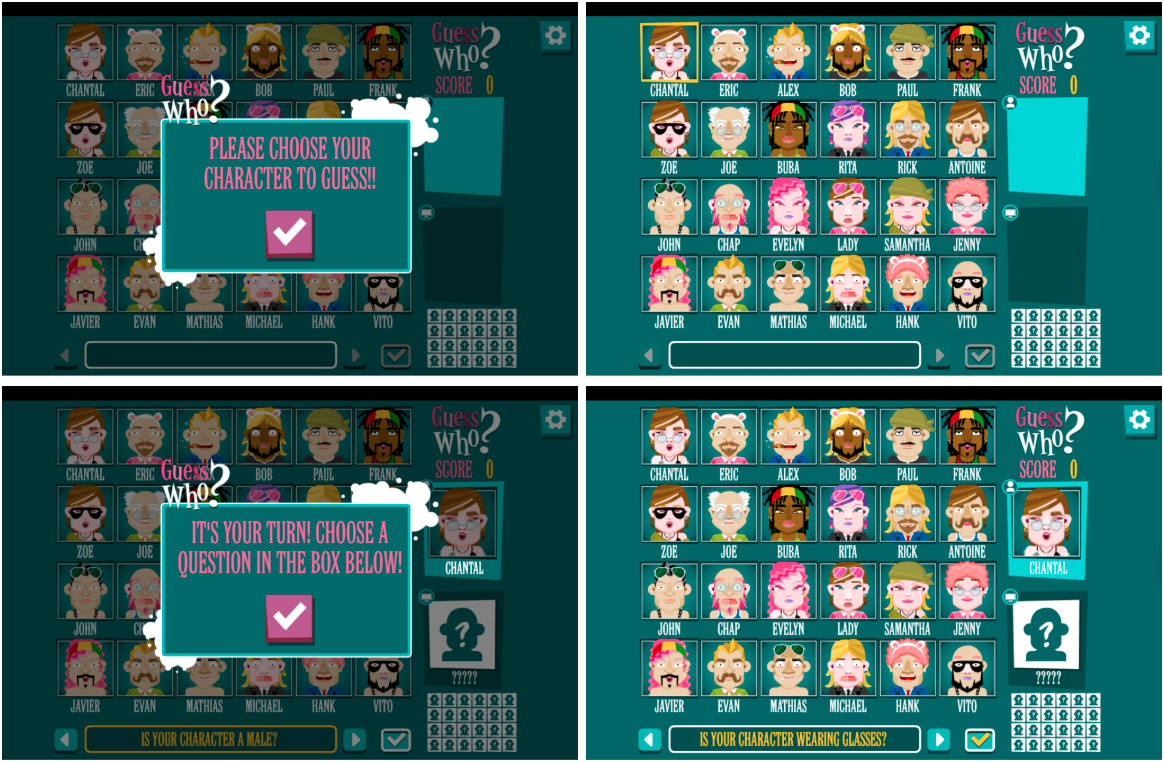
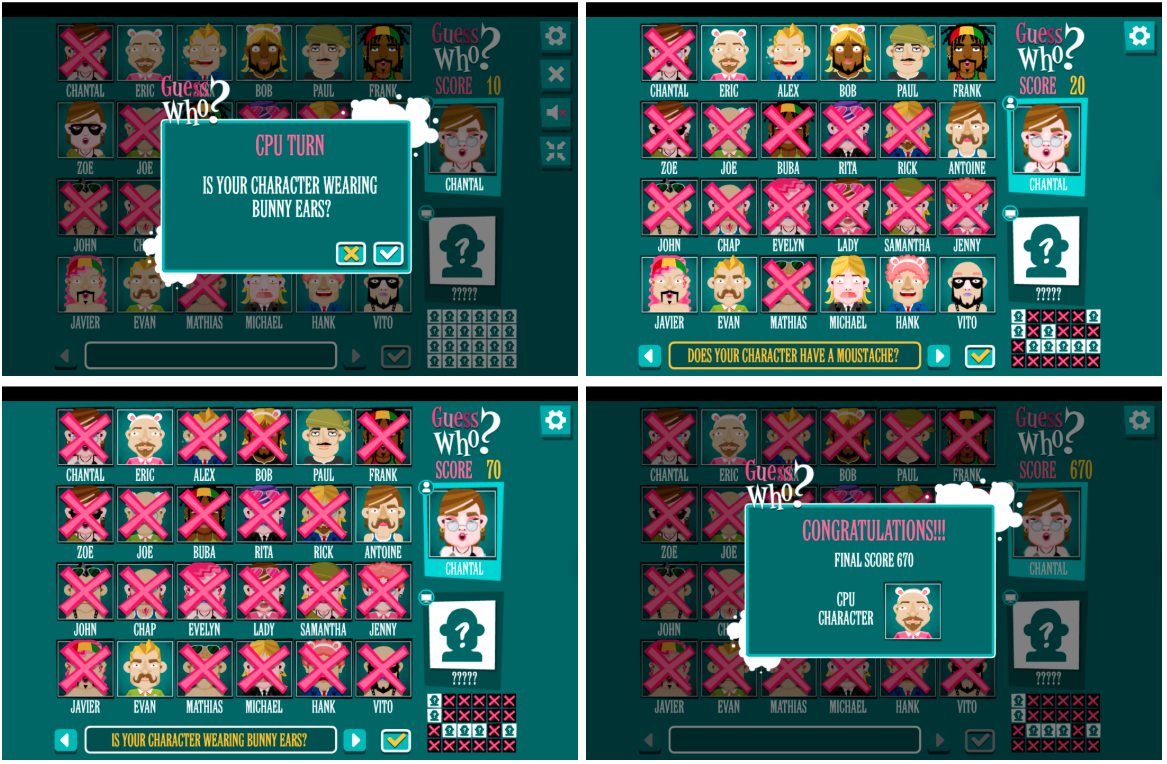
Once the play button is clicked, the website will prompt you to choose a character. There are 24 possible choices, so allow students time to observe the characters before selecting 1 as a class. Next, the website will prompt you to select a question to ask the computer player. The goal is to eliminate as many characters as possible during each round so you find the chosen character first. Some selected screenshots of progression through the game are provided here.
-
-
Welcome the DSU detective recruits back to training. Today's mission is to move from the crime scene to the suspects. Pose the following questions:
-
Do you have any ideas about who the Candy Culprit might be? Sample answer: No. So far, we have only looked at the crime scene evidence. We don't have any information about WHO might be involved.
-
What information might you need to start identifying people of interest? Sample answer: We could start with a list of all students and staff at the school. But there might be too many possible suspects, so maybe we can get a shorter list of people who were in the building at the time of the locker incident.
-
-
Bring back the Data Cycle: Display the current Data Cycle poster (LMR_U1_L01_B, page 2) on the board and remind students of the Consider Data phase they learned about in Lesson 1.
Concept Development
Part 1: Recording Observations
-
The school has provided the DSU with a list of all students, teachers, and support staff that have access to campus on any given day. Unfortunately, there are over 400 people on this list! Due to limited resources, there is no way the squad can investigate every single one of them.
-
Explain that our detectives will look through and analyze this data to build preliminary suspect dossiers. A dossier is a collection of documents about a particular person, event, or subject.
-
Ask: Is the data we are getting from the DSU an example of primary data? Why or why not? Sample answer: No. We did not collect the data ourselves. It is being provided to us by the DSU.
-
What do you think this type of data would be called?
-
Guide students to the understanding that this information already existed, and was gathered and recorded by the school. Because the data comes from someone other than ourselves, we call this secondary data.
-
-
The DSU Captain has decided to only investigate the people who were inside the building where the most recent candy heist occured. This narrows down our list of possible suspects to 30 people, including:
-
21 students (7 - 6th graders, 7 - 7th graders, 7 - 8th graders)
-
9 staff members (5 teachers, 1 administrator, and 3 support staff members)
-
-
The captain has confiscated the school ID cards of these 30 people and asked our Data Detectives to make observations from these cards in order to start creating a suspect dossier.
-
Place students into groups of 3 or 4 and hand out the Data Card sets (left side) OR provide a link to the Canva whiteboard template.
-
Students will be wearing their detective hats today as they examine the Data Cards. They need to identify any “clues” or information about the suspects that could give us some insight into a possible motive.
-
Emphasize that, for now, we only want to gather information that we can visually observe from the school ID photos. Provide the following questions to the detectives for them to consider as they record their findings:
-
What characteristics do the suspects have in common with each other?
-
In what ways are the suspects different?
-
Can these similarities and differences help us narrow down our suspect list at some point?

ADDITIONAL SUPPORT:
Optional Modeling of an "Observation" for Diverse Learners
Before students work in groups, model the process of observing a data card using the Fishbowl strategy, verbalizing the thought process by identifying different pieces of information (potential variables).
Optional Sentence Starters for Diverse Learners
"I observe that this person has (ex. eye color)."
"A characteristic I see is , and its possible values are , , or ."

STRATEGY:
Fishbowl
A small group of students (the “fish”) sits in an inner circle and engages in a focused discussion on a specific topic. The rest of the class sits in an outer circle (the “observers” or “aquarium”) and listens silently, taking notes on the inner group’s conversation. Occasionally, the teacher may allow an empty chair in the inner circle, allowing an outer circle member to temporarily join the discussion before returning to the outer circle. The strategy encourages deep listening and focused discussion by a few, while allowing the many to observe and analyze the dialogue. -
-
Encourage students to be creative and detailed with their initial observations.
NOTE: There is no “correct” way to organize this initial information yet. We want our detectives to be creative and do not want to set rigid guidelines. -
Whenever possible, they should record some actual numbers, or counts, for their observations. Some examples are below:
-
Example 1: There are 21 students and 9 adults.
-
Example 2: There are 7 students who are in the 7th grade.
-
Example 3: There are 7 people who are holding books in their photo.
-
Example 4: There are 2 people who wear glasses.

Enrichment or Extension:
Counts Vs. Proportions
Make a suggestion for students to calculate proportions as well as counts.
Example: 7 of the suspects are 7th graders. Since there are 30 total suspects, 7/30 = 0.233, so 23.3% of the suspects are 7th grade students. -
-
-
Whole Group Discussion: After teams have had time to discuss and record their findings, lead a class discussion about their visual observations.
-
What are some characteristics you observed about the people on the cards just from their photos? Sample answers are listed below:
-
Example 1: Grade level.
-
Example 2: Student or staff.
-
Example 3: Hair color.
-
Example 4: Item being held.
-
Example 5: Glasses or no glasses.
-
-
What are some characteristics you cannot observe from the pictures alone? Sample answers are listed below:
-
Example 1: Number of siblings.
-
Example 2: Travel method to school (bus, bike, car, etc.).
-
Example 3: Grade on the most recent math test.
-
Example 4: Favorite type of candy.
NOTE: It is important to think about who is and is not represented in these Data Cards. We may be assuming some information, but should be careful about how we do so. For example, recording a suspect’s “skin complexion” is likely better than recording an assumed “ethnicity,” but we should aim to record only the information that we know for certain based on the photos.
-
Part 2: Organizing Observations
-
-
Explain that a good detective knows how to organize evidence and then look for patterns. For the next task, students will physically group the data cards based on different observable characteristics.
-
Within their detective teams, challenge students to organize all 30 suspect cards into exactly 2 distinct groups based on a characteristic they observed from the photo.
-
If needed, guide teams with hints based on their written observations. Some example groupings are listed here:
-
Example 1: student (21) vs. staff member (9).
-
Example 2: wears glasses (2) vs. does not wear glasses (28).
-
Example 3: wearing a sports jersey (3) vs. not wearing a sports jersey (27).
-
Example 4: holding a book (7) vs. not holding a book (23).
-
-
Discussion: Once teams have chosen their criteria and physically placed their suspect cards into their 2 groups, allow each team to share out. Discuss if some criteria were easier or harder to apply consistently. Some example discussion ideas are listed here for reference:
-
Example 1 (simple):
Grouping the suspects into students versus staff is fairly easy because the staff members have an icon that indicates "STAFF" as their role. -
Example 2 (more complex):
Grouping the suspects by their hair length is a more difficult task because we first have to agree on what it means to have "long hair." Some students might decide that "long hair" must go past a person's shoulders. Others might suggest that their classification of "long" versus "short" depends on a person's assumed gender.
-
-
-
Next, challenge the detective teams to reorganize the 30 suspect cards into exactly 3 distinct groups based on a different observed characteristic.
-
If needed, some example groupings are provided here:
-
Example 1: hairstyles - (1) hair is in a ponytail or braids, (2) person is wearing a hair accessory such as a hat or headband, (3) hair is worn down.
-
Example 2: shirt color - (1) red, (2) blue, (3) other.
-
-
Discussion: Once again, allow the detective teams to share the criteria they used to organize the suspects into 3 groups. Some discussion ideas are listed here for reference:
-
This is a good opportunity to bring up nuances. For example, organizing by “skin complexion” might come up.
-
Facilitate a discussion around how making clear, objective criteria with well-defined categories is important for consistent grouping. Categories like “skin complexion” can often be subjective and vary greatly.
-
If 2 teams chose the same observable characteristic (like hair style), did they select the same criteria for their 3 groupings?
-
If so, were the suspects that were placed in each grouping exactly the same?
-
If not, how were their groupings different?
-
-
-
-
If time permits, repeat Step 14 by challenging teams to reorganize the cards into 4, 5, or 6 distinct groups.
-
Connect back to the Case of the Candy Culprit:
-
Remind students about the empty candy wrapper (from a chocolate bar) and the note that was left in the student’s locker.
-
While we do not have enough information to fully use clues yet, prompt the detectives to start thinking: “Based on what we know so far, who might be someone of initial interest?”
Closing
-
-
Lesson Recap: Students made detailed observations about potential suspects based on school ID photos. They practiced organizing these observations into groups based on specific criteria.
-
Key Takeaway: Emphasize that organizing evidence in different ways helps detectives look for connections and patterns in data, even with just visual information.
-
Transition to the next lesson: Announce that more information about the suspects will be provided during the next lesson, and teams will be asked to create their own displays that appropriately organize it.
-
Exit Ticket: What do you suggest be the next step in your investigation and why?